Electricity Generation Drops in May, reports StatsCan

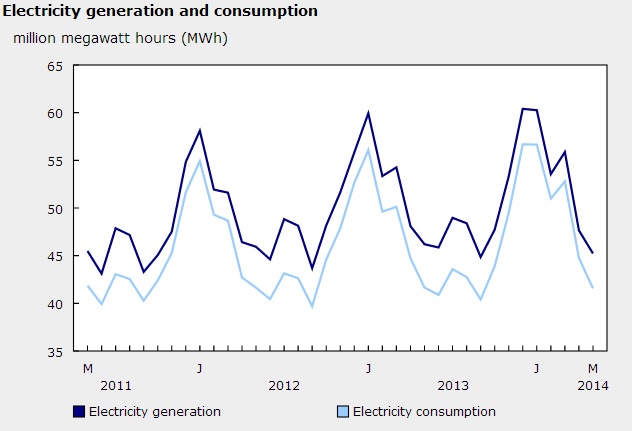
Electric power generation in Canada fell 2.1% to 45.2 million megawatt hours (MWh) in May when compared to the same month in 2013, reported StatsCan. Hydro power generation also declined, marking a 3.5% drop to 28.5 million MWh.
Overall electricity consumption decreased 0.2% from May 2013 to 41.6 million MWh, and generation by utilities dropped 2.2% to 41.4 million MWh. Industrial generation, meanwhile, saw its third consecutive monthly decrease, down 1.4% to 3.8 million MWh.
Ontario and Quebec See Decrease, Alberta on the Rise
Quebec produced 14.5 million MWh of electricity during the month, a 2.6% decrease from May 2013. That drop was attributed to lower hydro generation, StatsCan noted, although all other generation types in Quebec declined save for internal combustion which was up 5.8 percent.
In Ontario, electric power generation dropped a slight 0.7% from May 2013 to 12.0 million MWh. However, nuclear generation was up 2.5% to 7.5 million MWh. Those gains in nuclear generation were offset by combustion turbine, which marked a 30.9% drop, and steam, which fell 18.1 percent.
Alberta, on the other hand, saw an increase in generation by 3.9% to 5.1 million MWh in May. Steam generation posted the biggest increase, rising 4.8% to 3.6 million MWh.
Electricity Exports Down, Imports Up
Total electricity imported from the U.S. climbed 25.7% from May 2013 to 1.1 million MWh. British Columbia led the pack at 1.0 million MWh. Comparetively, however, this was down 20.2% from May 2013.
We’re not exporting as much as we’re importing as Canada’s total electricity exports to the United States fell 11.8% to 4.8 million MWh. Quebec led the provinces in exported electricity, sending 1.6 million MWh to the U.S, a drop of 20.2% from the same month a year earlier.