Comment des produits énergétiques bidirectionnels peuvent être une porte sur l’avenir
Réseau de transport électrifié, énergie renouvelable, énergie emmagasinée, réseau de distribution intelligent sont tous des secteurs où les produits énergétiques bidirectionnels – qui permettent de charger efficacement une batterie à partir du réseau électrique ou de toute autre source d’énergie renouvelable ou de retourner l’énergie emmagasinée vers le réseau de distribution – peuvent jouer un rôle important. Dans certaines conditions météorologiques les véhicules à traction intégrale peuvent constituer un atout important. Même chose pour la bidirectionnalité qui peut s’avérer un atout pour certaines applications.
Electrified public transit, renewable energy, energy storage and network smart power are all areas where bidirectional energy conversion products — where the energy can flow from the source to the load and from the battery to the source — can play a leading role.
In special weather or road conditions, AWD (all wheel drive) traction represents a definite advantage over FWD or even RWD. Similarly, the bidirectionality of power flow represents a competitive edge to provide new features or characteristics that can improve a given application.
Power + mobility + bidirectionality = a great combination
In EVs, the on-board charger transforms the A.C. power from the charging station into D.C. power to charge the battery. For most applications, when the EV is moving the on-board charger is at rest, doing nothing until the next charge.
On the other hand, if the charger is bidirectional, it can still perform some work while the EV is moving. Here’s an example: a new product from Convertronix, the BCAS20, is built into a compact housing for installation in public transportation EVs. At rest, it can charge the battery with a power of 19.2kW and support V2G (vehicle-to-grid) and V2H (vehicle-to-home) applications. When moving, its bidirectionality will allow conversion of energy from the battery for A.C. loads. In addition to reducing weight and cost, combined with mobility, the BCAS20 becomes a more effective solution.
Sample present-day applications: public transportation and energy storage
• Electric school bus. A school bus is a good application for electric transportation since the routes and schedules are well known, allowing the service provider to plan the time and locations for charging. In collaboration with a local partner, Convertronix is working on the development of a solution that will meet the requirements of a school bus. The company expects to test this product on the road later this year.
• Energy storage: IndieWatt environmentally friendly trailer. IndieWatt is a battery storage trailer first develop by Ingrid AG to produce cheese in the mountains of Switzerland. It makes good use of bidirectionality to first charge the battery from a clean energy source available at a given location and later give back that stored energy as A.C. power in a remote area. A crowdfunding project is underway to support further development, building and testing of such an improved battery trailer .
Future applications
• Electric transportation vehicles: electric buses and taxis are two types of vehicles offering great potential for efficiencies. On-board bidirectional chargers for public transportation could easily be integrated into a high-speed charging station.
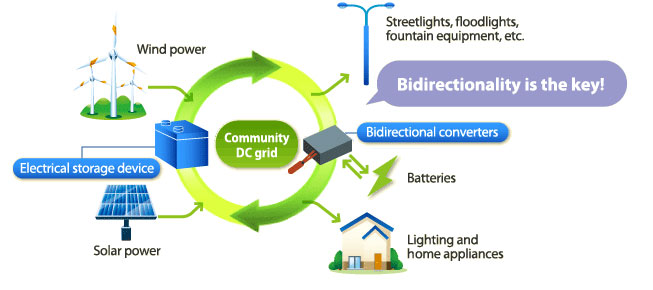
• Energy storage + bidirectionality + mobility. Bidirectional chargers allow for
1) energy storage from the grid or any renewable energy sources (solar and wind) into the battery and later
2) energy conversion from the battery either to the grid or to a load.
Integrating the battery-charger on a trailer would allowusers to move the energy from one location where it is readily available to another remote location where it is less available or unavailable. This technology has great potential for applications in developing countries where the grid is concentrated in urban areas and solar energy is easily available.
Maxime Caron is the co-founder and director of Convertronix. He’s been developing bidirectional power supplies for the automotive industry ever since and he has been thriving to revolutionize its industry.