Marquage d’équipement pour emplacements dangereux dans le nouveau
Bill Burr
Depuis mon dernier article sur cette question en janvier de l’année dernière, la Section 18 du Code national de l’électricité a été révisée en profondeur. Cet article constitue donc une importante mise à jour. Les environnements dangereux nécessitent toujours des exigences particulières pour l’équipement électrique, mais la révision en apporte de nouveaux.
Définition des emplacements dangereux
Selon les définitions dans le Code électrique canadien, dans le U.S. National Electrical Code, le CEI 60079-10 et CENELEC EN 60079-10, les emplacements dangereux sont définis lorsque des incendies ou des explosions peuvent résulter de la présence de :
• Gaz, vapeurs ou liquides inflammables (appelés classe I)
• Poussières combustibles (classe II)
• Fibres ou particules inflammables (classe III)
Les normes et les codes nationaux exigent que les équipements électriques utilisés dans des emplacements présentant ces conditions doivent être conçus et testés pour aider à réduire les risques d’explosions.
The Canadian Electrical Codedefines “hazardous locations” as premises, buildings, or parts thereof in which:
• an explosive gas atmosphere is present, or may be present, in the air in quantities that require special precautions for the construction, installation, and use of electrical equipment;
• combustible dusts are present, or may be present, in the form of clouds or layers in quantities to require special precautions for the construction, installation, and operation of electrical equipment; or
• combustiblefibres or flyings are manufactured, handled, or stored in a manner that will require special precautions for the construction, installation, and operation of electrical equipment.
In addition dust is further defined asa generic term that includes both combustible dust (particles <500um) and combustible flyings (particles and fibres>500um). Combustible dust is further divided into conductive dust (combustible metal dust) and non-conductive dust (combustible dust other than conductive metal dust)
The code requires that electrical equipment used in such locations be designed, tested, and certified to help reduce the incidence of explosions.
The traditional, North America, hazardous locations defined by a combination of classes and divisions as been entirely relegated to Appendix J for legacy installations, although equipment marked under the Class and Division rules may still be installed conditionally.
In the new Section 18 of the 2015 edition of the Code Zones 0, 1, and 2 still cover explosive gas atmospheres, however, explosive dust atmospheres are now covered as Zones 20, 21, and 22.
In addition, there have been some changes to markings for acceptable equipment.
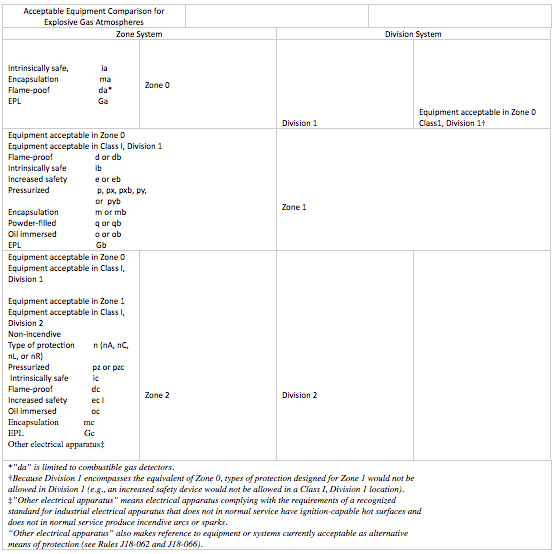
The following overview table shows either the type of equipment permitted or the types of protection acceptable for use in the Zone and Division systems.
This table is adapted from a similar table(J1.2) in Appendix J of the Canadian Electrical Code.
The new marking requirements are contained in rule 18-052 Marking
(1) Electrical equipment intended for use in explosive atmospheres shall bemarked with the following:
(a) the letters “Ex”
(b) the symbol(s) to indicate a method(s) of protection used; (as in Table J1.2above)
(c) the group as specified in Rule 18-050(2) or 18-050(6)
(d) the temperature rating in accordance with Subrule (2) for equipment of theheat-producing type
(e) the equipment protection level (EPL) Ga, Gb, Gc, Da, Db, or Dc asappropriate
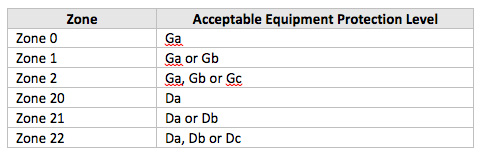
(2) Electrical equipment for use in explosive gas atmospheres shall be marked with
(a) the maximum surface temperature in degrees Celsius, or
(b) one of the following temperature codes to indicate the maximum surface temperature
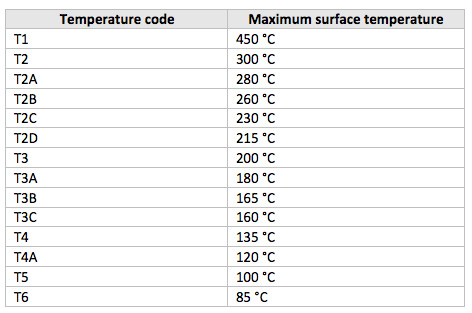
(3) If no maximum surface temperature marking is shown on equipment for explosive gas atmospheres, if of the heat-producing type, shall be considered to have a maximum surface temperature of 100 °C or less for the purpose of compliance with Rule 18-054.
(4) The marking shall specify the temperature class or operating temperature at a 40°C ambient temperature, or at the higher ambient temperature if the equipment is rated and marked for an ambient temperature of greater than 40°C.
(5) Electrical equipment for use in explosive dust atmospheres shall be marked with the maximum surface temperature in degrees Celsius, preceded by a “T”.
For more detailed information on markings required on hazardous equipment, please refer to the Canadian Electrical Code.
These new marking requirements contained in the 2015 23rd edition of the Canadian Electrical Code will be effective in your area only when adopted by your jurisdiction. Check with your Authority having Jurisdiction.
William (Bill) Burr is the former Chair of the Canadian Advisory Council on Electrical Safety (CACES), former Director of Electrical and Elevator Safety for the Province of BC, and former Director of Electrical and Gas Standards Development and former Director of Conformity Assessment at CSA Group. Bill can be reached at Burr and Associates Consulting;billburr@gmail.com.